What happens today
Loss is found by the operator seeing it, by a spotter, or by the crusher. A visual walk-around catches a missing tooth eventually, and a tooth already in the load chain is found downstream when something breaks.
GET loss detection
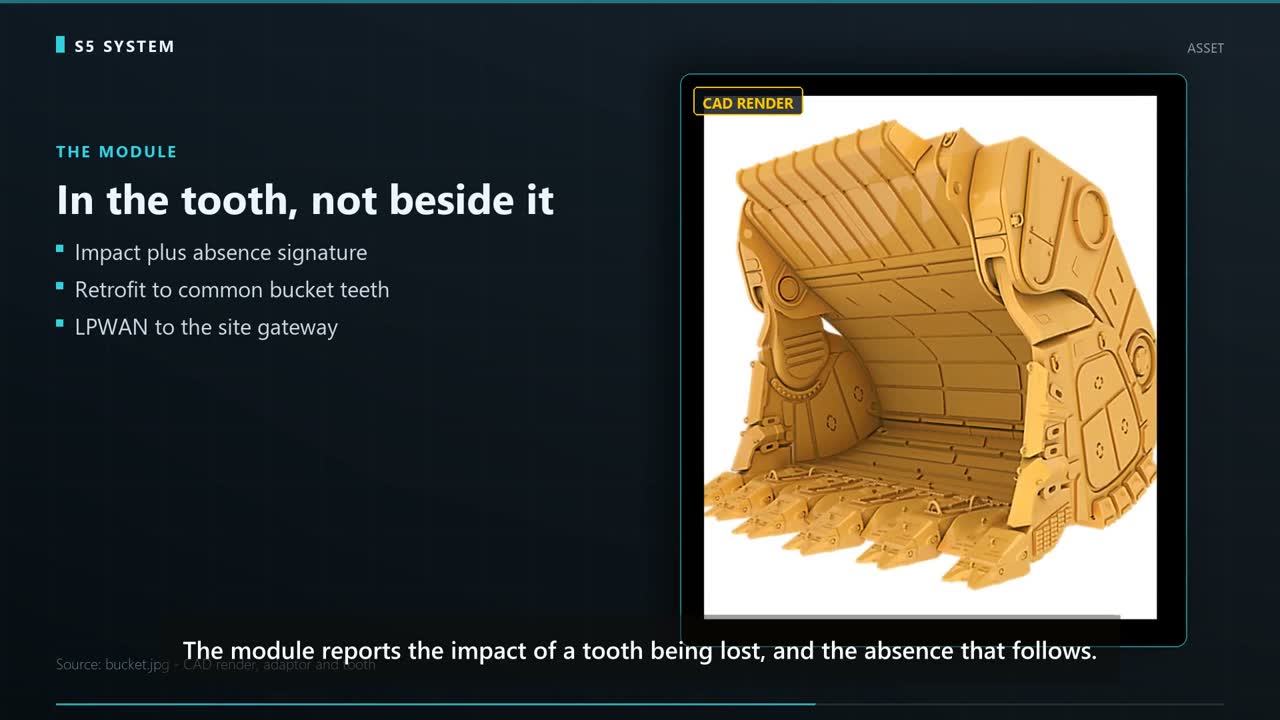
GETsmart senses a ground-engaging-tool assembly leaving the bucket, and the change in seating condition that comes before it, so the operator hears about it while the machine is still at the face. After the bucket, there is nowhere safe to intercept it.
A ground-engaging-tool tooth coming loose is a short, violent and expensive event. From the bucket the tooth rides the load chain, and the last place it can be found is the crusher chamber, where a piece of hardened steel stops a plant. Between the face and the crusher there is no safe place to intercept it, which makes the bucket the only useful detection point.
Loss is found by the operator seeing it, by a spotter, or by the crusher. A visual walk-around catches a missing tooth eventually, and a tooth already in the load chain is found downstream when something breaks.
Sensing in the bucket reports the assembly leaving its seat, and reports the seating change that precedes it, so a tooth that is working loose is a maintenance task at the face rather than a recovery job at the crusher.
Sensing embedded in the bucket, an in-cab indication, and a record of every event with the machine and the shift.
The sensing is embedded in the bucket rather than added to the tooth, so a tooth change does not disturb the detection and the system survives normal GET replacement.
The change in seating condition that precedes a tooth working free is reported separately from the loss itself, which is what turns a detection into a warning.
Every event is kept with the machine, the shift and the time, so a pattern across a bucket or a fleet of teeth is visible rather than anecdotal.
GETsmart ships as bucket sensing and an in-cab indication per machine, with the event record that keeps tooth position, machine and shift together.
The sample record shows the two states separately: a seating change that gave warning, and a loss event where the warning was not acted on. The record is illustrative and is not a capture from a customer's machine.
Sample record. Values are illustrative and are not customer data.
The moat is the seating-change signal ahead of the loss. A system that only reports a missing tooth saves the crusher but wastes the warning; one that reports the tooth working loose turns the event into routine maintenance.
GETsmart reports on the positions where sensing is fitted, so a bucket fitted at some positions has those positions covered and no others. It does not prevent a tooth from coming loose, and it does not detect a tooth that has already passed beyond the bucket. Detection depends on the sensing surviving normal bucket duty, which is why fitment is part of the product rather than an accessory. The kit is built to order, and supply timing is confirmed in the written quotation.
GETsmart measures and reports what its sensors see. That is monitoring, not a compliance or safety certification: the log is evidence of what the equipment recorded, and nothing on this page, in the quotation or on the invoice certifies your site, your process or your equipment against any standard.
GETsmart, on film. The video plays from YouTube only when you press play; until then this page requests nothing from anyone else.
Telemetry shown is illustrative — default values, not a measured test. CAD render — no built sensor exists yet. Watch on YouTube (opens youtube.com).
One product page S5 owns. The first 3 years of service are included in the up-front project price; from year 4 the subscription is A$10 per site / month. The hardware and the scope are quoted against a site assessment, and the quotation carries that figure. Nothing is sold directly from this page: the listed price is recorded through a written quotation, and the quotation states the lead time, the freight and the payment terms for your site.
| Piece | What happens | Status |
|---|---|---|
| Quotation | A written quotation is issued for this page and the configuration shown | Issued on request |
| Buy now | Opens the quotation page: the listed price is recorded against a written quotation, no order, no payment | A$10 held |
| Lead time and freight | Stated in the written quotation for your site | Confirmed in the quotation |
| Commercial quote | A quotation reference is issued for this page and configuration | Instant, same page |
| Subscription, from year 4 | The first 3 years are inside the quoted price | Not charged today |
One email address and your configuration, and the quotation for this GETsmart build is issued against this page. No account, no sales call required.
Direct answers to the questions buyers, installers and AI search tools ask about GETsmart.
It detects two states: a ground-engaging-tool assembly leaving its seat in the bucket, and the change in seating condition that precedes it. The first tells the operator that a tooth is loose or gone, and the second is the warning that a tooth is working free. The distinction matters because only the second gives anyone time to act before the loss.
Between the bucket and the crusher there is no safe place to intercept a piece of hardened steel. Conveyors and transfer points are not designed to stop it, and the crusher chamber is where the damage is done. The bucket is the only location where the loss can be acted on, which is why the sensing is embedded there rather than added to the plant.
It is fitted to the bucket, so the normal GET replacement cycle does not disturb the detection. A tooth change is a routine event on a working machine, and a system whose sensing was attached to the tooth would need re-commissioning every time the teeth were changed. Bucket fitment keeps the detection stable across the wear life.
An in-cab indication is raised when the seating condition changes, before the assembly leaves the bucket. The operator then stops and inspects at the face. An indication only works if the operator understands what it means and is expected to act on it, so agreeing that response with the crew is part of commissioning rather than an afterthought.
It covers the positions where sensing is fitted, and the fitment plan is the engineering decision at the start of an order. Most sites begin with the positions whose loss has the highest consequence, then extend coverage as the record shows where events actually occur. Positions without sensing are outside the system's view and are reported as such.
Each event is kept with the machine, the tooth position, the shift and the time, which is what allows a site to see a pattern rather than a single incident. The record supports a conversation with the GET supplier about seating, retention and wear, because a repeated seating change at one position is evidence about that position rather than bad luck.
It is quoted per bucket, because the number of sensed positions and the machine interface both change the kit. The quotation states the sensed positions, the in-cab indication and the first 3 years of the subscription, and it separates fitment from supply. Nothing is charged on this page; Buy now only records the price against a written quotation.
No. GETsmart detects and warns; it does not retain the tooth. Retention remains a matter of the GET system, the seating procedure and the ground conditions. What the product changes is how quickly a site learns that a tooth is working free, which is the difference between a reseat at the face and a recovery job at the crusher.
GETsmart is quoted per site for the hardware and the scope described here. The first 3 years of service are included in the up-front project price; from year 4 the subscription is A$10 per site / month. The quotation is issued against the site assessment and states the delivery, invoicing and payment terms before anything is committed.
GETsmart ships as a kit: GETsmart ships as bucket sensing and an in-cab indication per machine, with the event record that keeps tooth position, machine and shift together. No S5-designed radio enclosure is required, because the site gateway is a finished product bought off the shelf. Installation is a guided self-install, and the site needs mains power or the supplied battery option at the gateway location.
GETsmart is quoted against a written commercial quotation. The quotation states the configuration, the price, the lead time and the freight for your site, and sets out the ordering, invoicing and delivery terms before anything is committed.
Use the “Get instant commercial quote” form on this page, which needs only your email address and your configuration choice. The store records the request against the getsmart subdomain and issues a quotation reference, so the enquiry is traceable rather than lost in a mailbox. You receive the quotation for the configuration and price shown; nothing is ordered and nothing is charged until you accept it, and the Request a quotation button is what records your interest.
A GETsmart failure is recorded as evidence and handed to the operator, not silently retried. The record keeps the measured values, the time of the event and the limit that was crossed, and the response is a documented action by your team, not an automatic decision by the device. A missing reading is treated as a missing data point, not as a pass.
Service desk, S5 System Pty Ltd. A support engineer answers, usually within one business hour.
WAWhatsAppMessage or call +61 468 728 893 TGTelegramCall or chat +61 468 728 893 ☎Phone+61 468 728 893Talk to an S5 engineer about whether GETsmart fits your site. Pick a time that suits you. The call is free and there is no obligation.
Questions on fit, price, setup or commissioning? A support engineer replies to every enquiry.
One email a month: what actually failed, what the sensors caught, and what it cost. No product pitches.